· Ben · content · 6 min
How often should a startup publish blog posts? One a day, not fifty on Tuesday
Google has said publishing frequency isn't a ranking factor, which makes cadence an operations problem instead of an SEO one. Here's why one reviewed article a day beats fifty dropped on a Tuesday, and what daily cost and returned for us.
Two failure modes, same blog. In the first, the archive stops four months ago and the newest post announces the seed round. In the second, an agency drops twenty posts in a single week, invoices, and disappears. The next entry is dated a quarter later.
The second one looks better on a dashboard. Twenty posts is twenty posts. But nobody read them. Nobody reviewed them, half of them contradict the pricing page, and the whole batch landed as one blob on a Tuesday in March.
So: how often should a startup publish blog posts? My answer is one a day, and the reason has almost nothing to do with search. Same annual output, completely different risk profile. It's a batch size question, and engineers already have the mental model for it.
The number everyone quotes is a decade old
Every frequency post on page one eventually reaches for the same finding: companies publishing 16 or more posts a month generated about 4.5× more leads than companies publishing four or fewer, from a study of more than 13,500 companies. It's a correlation, drawn from one vendor's customer base, and it predates helpful-content updates, AI Overviews, and every content tool you're currently evaluating.
It's also arithmetically hostile to a startup. The 2025 edition of Orbit Media's annual blogging survey puts average article creation time at just under three and a half hours. Sixteen articles a month is roughly 55 hours. That's a third of a full-time person on a team that has no content hire and no plans for one. That's why the archive stops four months after the seed announcement. The advice wasn't wrong about the number, it was silent on where the hours come from.
Then the same pages hedge. The category's most-linked frequency guide recommends six to eight posts a month for a young blog, two to four for a complex niche, and cites a founder who publishes once every one to two months as proof the convention doesn't hold. Page one contradicts itself inside a single scroll. That's what "it depends on your resources" looks like when nobody wants to name a mechanism.
Google doesn't care how often you publish
This framing goes first, because the rest of the argument leans on it.
Asked directly whether a site publishing a page a day outranks a site publishing a page a week, John Mueller said he doesn't think so. Many factors go into ranking, and for one page a day versus one page a week the ability to crawl it is trivial. Crawl budget only becomes a topic at millions of pages a day. A couple of pages a day, or even tens of thousands, gets crawled in reasonable time.
Consistency is not a ranking factor. Nobody at Google is rewarding your streak.
Which is good news. Cadence isn't an SEO setting you're getting wrong, it's an operations setting, and operations settings you can reason about.
So it's a batch size question
Fifty posts on Tuesday is a quarterly release. One a day is continuous delivery.
You already know how this ends, because you've watched it happen with code. The quarterly release is a 40,000-line diff that nobody reviews, because nobody can review 40,000 lines. It merges on faith. When something's wrong you find out in production, and you can't tell which of the fifty changes did it. Continuous delivery is a small diff, one reviewer, one comment thread, and a revert that costs nothing.
Content behaves the same way. A batch of fifty arrives with fifty chances to be off-voice, off-fact, or duplicated against something already in the archive, and a review budget of zero. One article arrives as a diff you read on your phone in four minutes. If the second paragraph is wrong, you say so in a line comment and it comes back fixed.
The annual throughput is identical. The probability that any individual article is good is not.
Fifty on Tuesday is the shape the policy is looking for
There's a newer reason big-bang publishing is a bad trade. Google's spam policies now name scaled content abuse: many pages generated primarily to manipulate rankings rather than help users, typically large amounts of unoriginal content providing little to no value, and the policy is explicit that this applies no matter how the content is created.
Read that last clause carefully, because most coverage of it doesn't. The rule is about volume without value. It isn't about automation, and it isn't about whether a human typed it. A human agency dumping fifty thin posts in a week produces exactly the pattern the policy describes. A pipeline producing one researched, reviewed, sourced article a day does not.
Fifty on Tuesday is what a violation looks like from orbit, even when everybody involved had good intentions. One a day looks like a blog.
The bottleneck is review, not writing
Three and a half hours per article is the creation number. I have yet to see a frequency guide that budgets a single minute for editorial review, which is odd, because review is the part that actually fails.
Do the arithmetic on the batch. Fifty articles reviewed properly is something like 170 hours of reading in one week. Nobody has 170 hours in one week, so the batch ships unreviewed, and "we publish fifty a quarter" quietly means "we publish zero reviewed articles a quarter."
At one a day the review is small enough to survive contact with a normal week. This is the whole reason Contentcron ships articles as pull requests instead of into a dashboard: the diff is the unit of review, and it lands where your team already argues about things. A general comment or a line-level comment on the PR comes back as a revision commit on the same branch, usually in about a minute, with multiple comments batched into one coherent revision. If you want the longer argument for that workflow, I wrote it up in review content the way you review code.
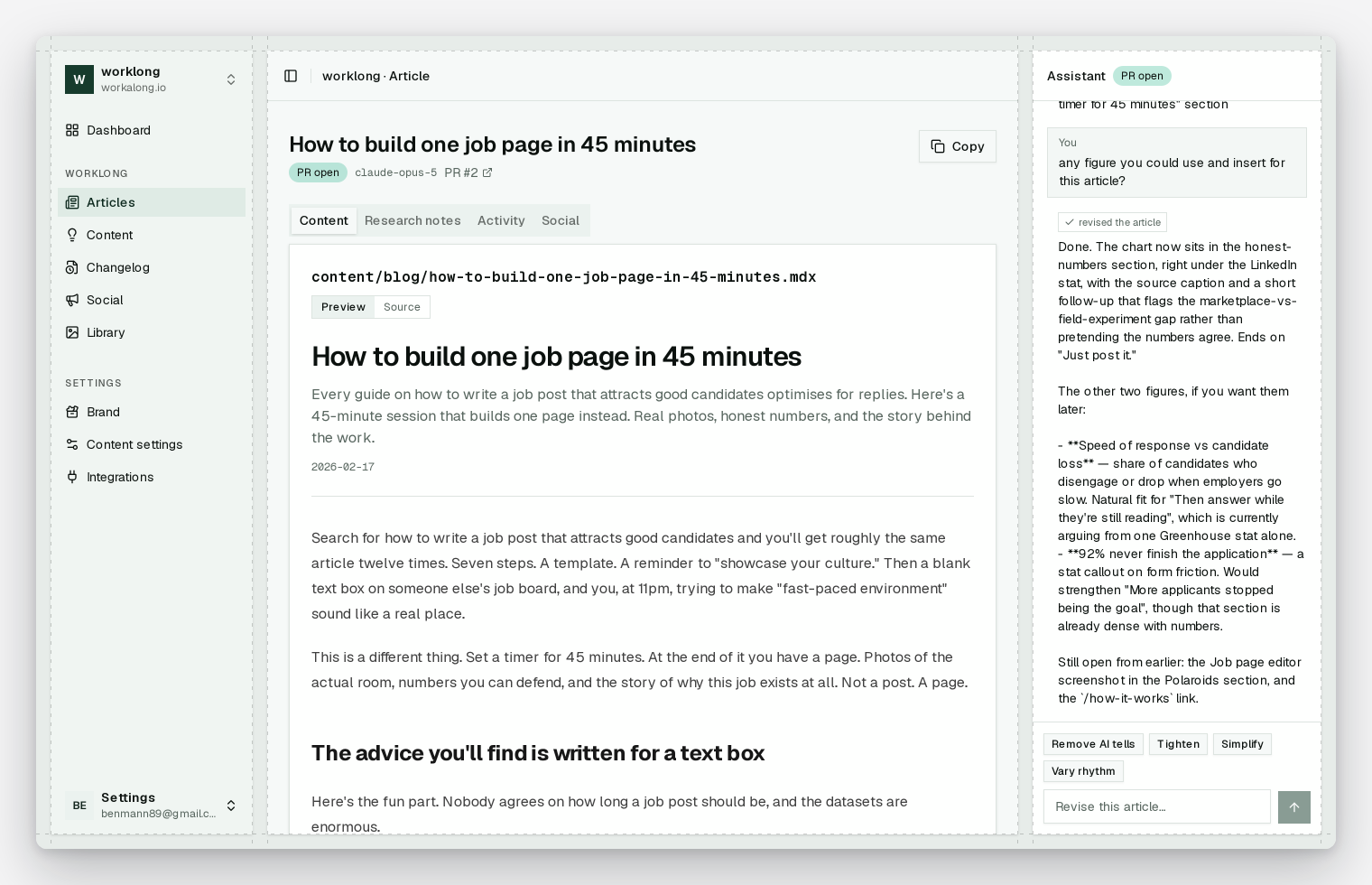
Four minutes a day is a habit. Four hours on a Tuesday is a meeting nobody schedules.
What one a day actually bought us
Grepture is my other product, and its blog has run on Contentcron since day one at roughly one article a day. First eight weeks in Google Search Console: 318 clicks and 43,627 impressions, with impressions climbing from near zero in early May to about 1,800 a day by late June. The unedited screenshot and the full read of that data are in our first eight weeks of Search Console.
That's evidence that a daily cadence of ordinary, reviewed, sourced articles compounds from a cold start, and that nothing got suppressed for being machine-assisted.
It isn't a case study about your market, your domain authority, or your sales cycle. Eight weeks is eight weeks. One site, one niche, n of 1. I'd rather hand you the number with the caveat attached than round it into a testimonial.
A refresh spends an article
One more thing the frequency guides skip. Publishing throughput isn't only new posts. Content decays, and updating a post that used to rank is a publishing decision competing for the same slot as a new one.
We're blunt about this in the product: a refresh of a decayed article counts as an article against your monthly allowance, because it's a full pipeline run. Research, outline, written MDX, PR. The honest version of "one a day" is one slot a day, and some days the highest-value thing in the queue is a 2024 post whose impressions have been sliding for a month. If you want to find those before you guess at them, 40 lines against the Search Console API will hand you the list.
What this isn't an argument for
It's not an argument for more words. Orbit's data has the average article down to 1,333 words and the skyscraper arms race reversing. But the same survey won't let me claim length is the enemy either. Among 808 marketers, 37% of the high-frequency publishers report strong results and 39% of the long-form writers do, against a 21% benchmark across everyone who answered.
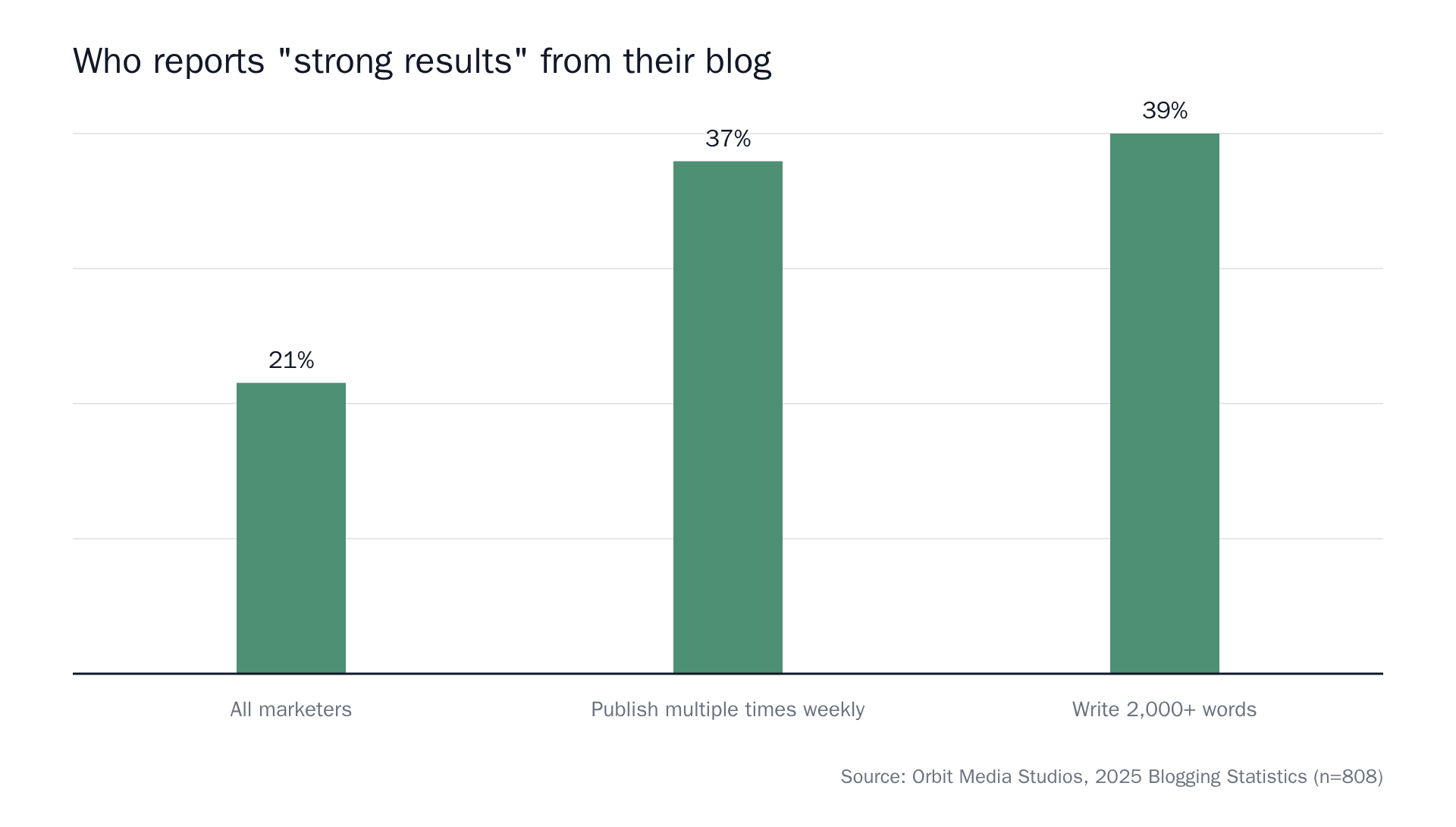 Source: Orbit Media's 2025 blogging survey, 808 marketers.
Both bars clear the benchmark, which means cadence and depth aren't trading against each other. Neither one is the mechanism. What's being measured in both columns is effort that someone kept up, and a post long enough to say the whole thing is not the same object as a post padded to a target. Padding to hit a word count is the same mistake as dumping fifty on a Tuesday, just at a smaller scale.
It's not an argument for a "generate 50 posts" button. There isn't one in Contentcron and there never will be. The cap is one article a day per project by design, because that's the batch size a person can review, and an unreviewed article is worth less than no article.
And it's not an argument that daily is magic. If you can defend two genuinely good posts a month and no more, publish two a month, on a schedule, forever, and stop reading frequency advice. The cadence you can hold beats the cadence you can justify.
Pick a cron and stop negotiating
I like a daily cadence for a reason that has nothing to do with Google, because Google doesn't reward it. A schedule ends the argument. There's no monthly debate about whether this is the week for content. The run fires, a PR shows up, you read a diff, you merge or you comment.
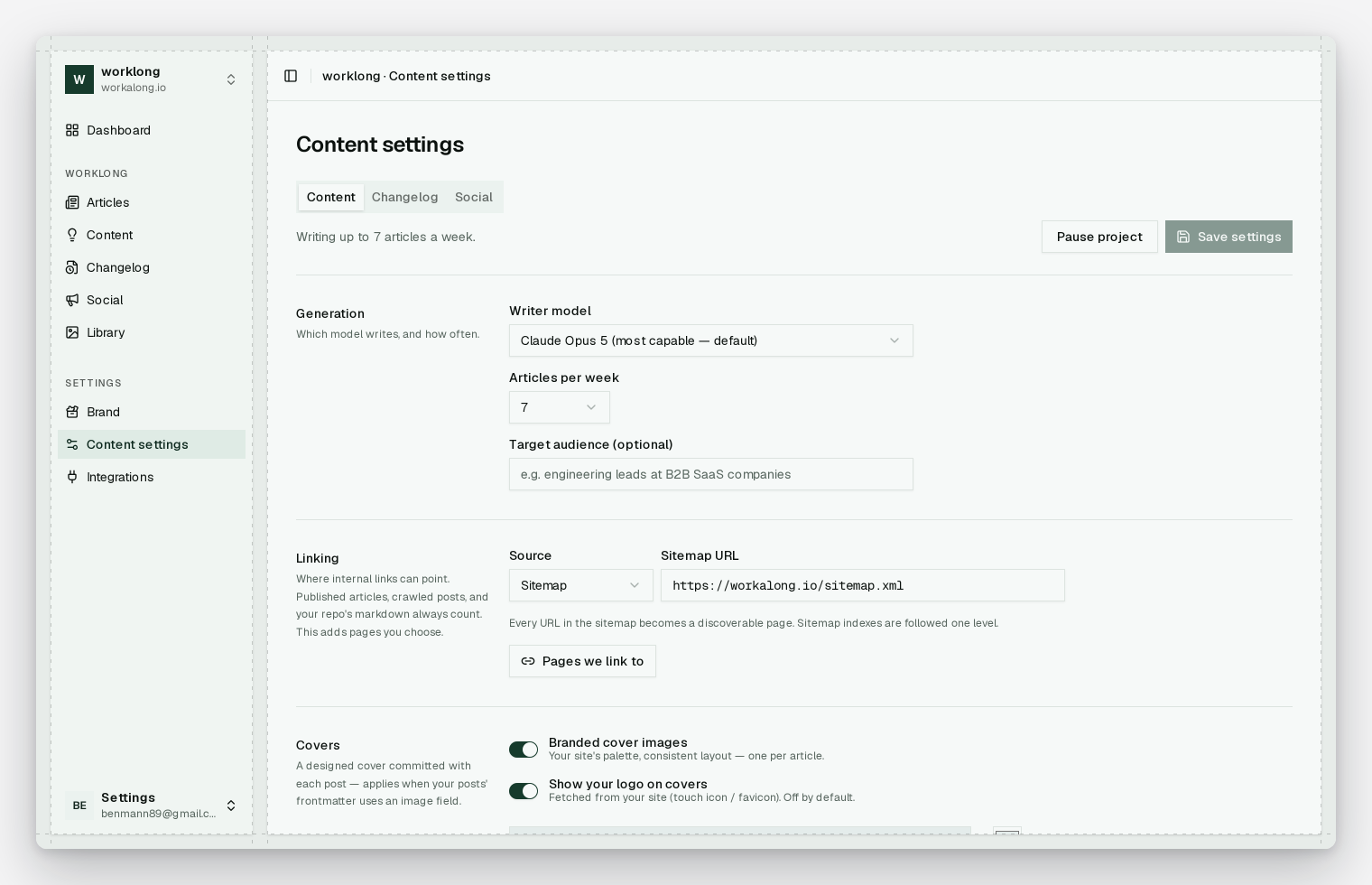
0 6 * * *. Cadence is a per-project setting, and daily is just the default I'd defend.
If your blog is a folder of markdown, your archive has a four-month hole in it, and the next plan on the table is paying someone to drop twenty posts in a week, try the other batch size first. The first article is free, no card required.