· Ben · seo · 6 min
Does Google penalize AI content? Our first eight weeks of Search Console
No AI penalty exists. Scaled content abuse does, and it arrives as a notice in Search Console. Here's the unedited report for a blog written end to end by Contentcron, 318 clicks and 43,627 impressions in eight weeks, plus what that data can and can't prove.
318 clicks. 43,627 impressions. Eight weeks, one new domain, every post on it written by an AI pipeline and merged by a human.
That's Grepture, my other product. Its blog has been written by Contentcron since the day the repo existed, and the Search Console report is on our homepage as an unedited screenshot, date range and all. 318 clicks is a small number. I'd rather say that first than have you notice it.
I'm publishing it because nobody else in this SERP publishes their own. Search for whether Google penalizes AI content and you get policy explainers quoting the same two sentences from Google, or detector vendors scoring somebody else's top-20 results. Useful, but none of it tells you what actually happens to your graph when you start shipping.
There is no AI penalty. There is a scaled content abuse policy
Google's position has been in writing since February 2023: "Appropriate use of AI or automation is not against our guidelines. This means that it is not used to generate content primarily to manipulate search rankings." Same post, same page: "Using AI doesn't give content any special gains. It's just content."
The thing people are actually scared of got a name in March 2024. Scaled content abuse: "many pages are generated for the primary purpose of manipulating Search rankings and not helping users." The FAQ on that announcement is blunt about authorship being beside the point. The policy applies whether automation or humans are involved.
Read the spam policy text and the trigger is volume without value, not a model. The example Google gives is "using generative AI tools or other similar tools to generate many pages without adding value for users." Many pages. Without adding value. Both halves have to be true.
What a penalty actually looks like in Search Console
"Penalize" is doing three jobs in that query and they need splitting.
A manual action is a notice in your Search Console account, sitting under Manual actions, with a reconsideration request path attached. It's an object. You can open it.
An algorithmic demotion is a step change in impressions with no notice anywhere. Harder to read. A core update looks like that. So does a seasonal dip, or your competitor finally writing the page you never wrote.
The third one isn't a penalty at all. It's your post never ranking, which is the default state of every post ever published, human or otherwise. Most people asking whether Google penalizes AI content are living in the third case and diagnosing the first.
If you don't have a notice in Search Console, you don't have a penalty. You have a ranking problem, and those have different fixes.
The 850,000-page version of getting it wrong
The policy does get enforced, and hard. Glenn Gabe documented a case in April 2026: a site running a /us/ directory of 100% AI-generated local news, 850,000-plus URLs indexed, hit with a scaled content abuse manual action. Visibility collapsed in blue links, and it collapsed in AI Overviews and AI Mode at the same time. ChatGPT citations fell with it, because the sources those systems lean on trace back to the same index.
That's the shape of the actual risk. Not "you used a model." Eight hundred fifty thousand pages of nothing.
What the curve looked like week by week
Near zero in early May. Roughly 1,800 impressions a day by late June. Clicks trailing impressions the entire time, which is what you'd expect when you're ranking on page two or three of long-tail queries and nobody is scrolling that far yet.
The first three weeks have nothing in them worth reading. Indexing is not ranking, and a new domain spends its first stretch just getting pages into the index. The only signals with any information in them were pages indexed and the first stray impressions on queries nobody would bid on.
Weeks four through six is where the curve starts bending, and it bends because there are more pages, not because any single page got better. One article a day compounds arithmetically before it compounds any other way. By week eight there were enough posts that the long tail had actual surface area.
The shape is a new-domain shape. I've seen it on human-written blogs. No notch in it, no cliff. Nothing that looks like a system deciding it didn't like the authorship.
What eight weeks and one site can't tell you
n=1. New domain, low volume, no control group, and I'm the founder of the tool that wrote it. Take all of that at face value.
This rules out exactly one hypothesis: that Google detects AI-written posts and suppresses them on sight. If that were true, the graph would be flat. It isn't flat.
It doesn't prove that the AI writing caused the growth. I can't separate that from "a new blog published forty-odd posts on a topic with no competition." Any honest read of a single site's first eight weeks gets you to not suppressed, and stops there.
What would falsify it: a step drop in impressions with no core update to blame, a manual action notice, or a six-month curve that flattens while the publishing cadence holds. I'll publish all three if they show up.
The data everyone else is citing, read honestly
The good third-party numbers don't say what the headlines say, in either direction.
Ahrefs crawled 331,000 pages in July 2026. 5.3% of positions one through three were 100% AI-generated, 9% were at least 80% AI. Indexation ran 49.28% for low-AI pages against 40.35% for very-high-AI pages, and low-to-moderate AI pages pulled two to three times the impressions of the high and very-high buckets. No precipitous drops over time. Their own caveat is the important one: sites leaning heavily on AI content tend to be newer and lower-authority to begin with, so you're looking at a gradient, not a classifier.
Semrush, across 42,000 blog pages, found position one has about an 80.5% probability of being human-written against roughly 10% AI, and that the gap narrows sharply from position five down. The top spot is genuinely different. Positions four through ten are a fight you can win.
Originality.ai's longitudinal series has AI-scored pages going from 2.27% of top-20 results in February 2019 to 19.56% in July 2025, dipping to 7.43% around the March 2024 update. And Graphite's data, via Axios, put roughly 48% of new articles as AI-generated by May 2025 while 86% of articles actually ranking were human-written.
All of that is consistent with one story: average AI output is worse, and worse content ranks worse. The correlation is real and it's not about the model.
The constraints that keep a daily pipeline out of the scaled-content bucket
Google's quality rater guidelines, section 4.6.6 as of the January 2025 update, tell raters to give the Lowest rating when the main content is "copied, paraphrased, embedded, auto or AI generated, or reposted from other sources with little to no effort, little to no originality, and little to no added value."
Read the conjunction. AI generation sits in a list next to an effort test, an originality test and an added-value test. Those are process properties, and process is something you can actually build against.
So here's ours, and every item is checkable in a repo.
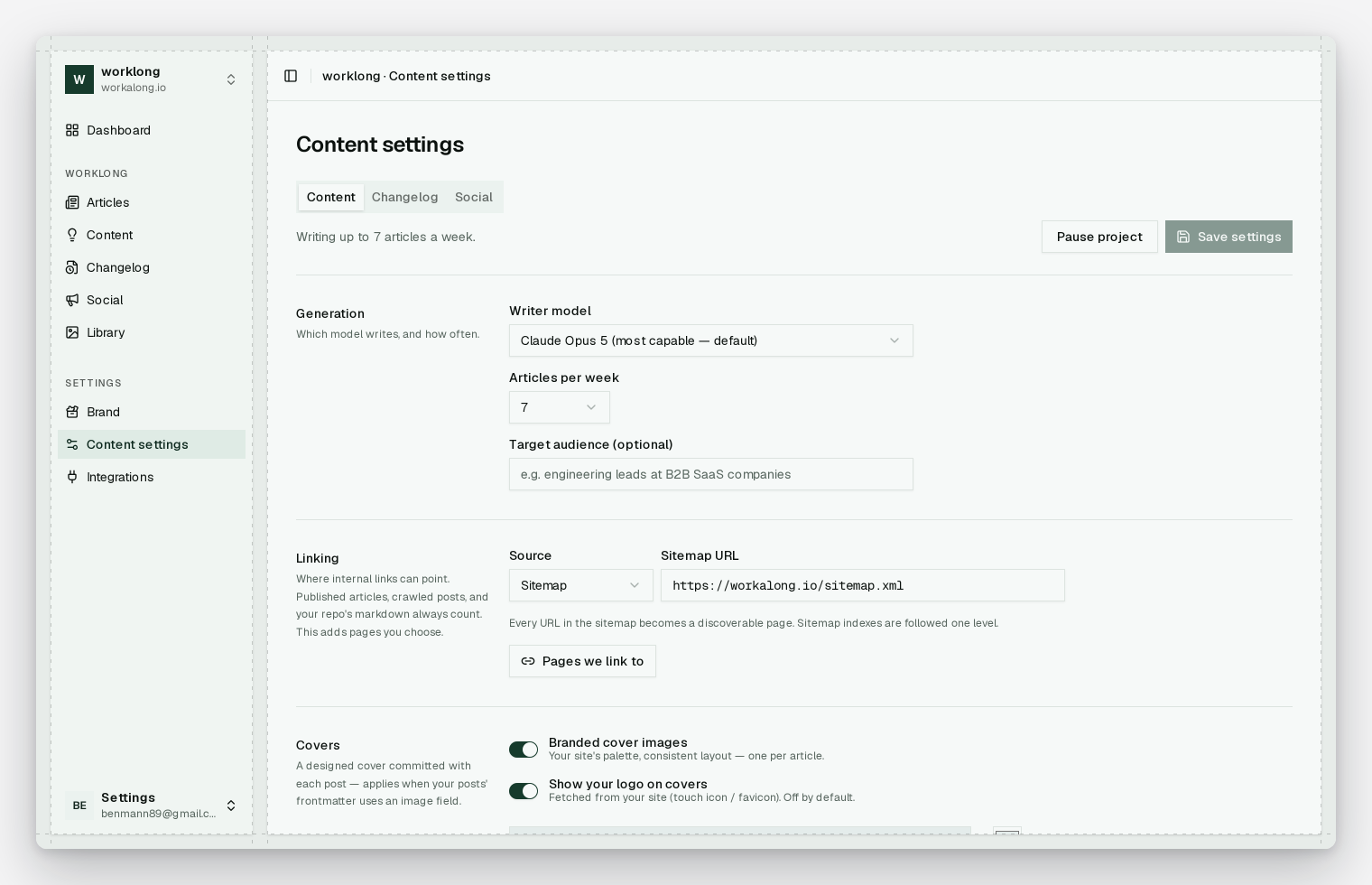
One article a day. Cadence is a per-project setting and the ceiling is thirty articles a month, because there is no bulk generate button and there never will be. Scaled content abuse starts with the word scaled.
Every article arrives as a pull request on contentcron/<slug> and a human merges it. Nobody is ticking a compliance box there. That review is where the effort goes in. Comment on the PR and it revises.
Figures cite a source or they don't exist. Charts print the source inside the image. No AI image generation anywhere in the product, and the screenshots are real captures of the product being written about, pixel-diffed so a URL only changes when the UI does. Section 4.6.7 of the rater guidelines describes paraphrased content as the kind that only contains commonly known information and summarizes one other page without adding anything. That reads like a QA checklist, and I've been treating it as one. The full argument for why the pipeline is built this way is in the launch post.
Bylines and disclosure
Google answered this one directly in the same 2023 post. Consider a disclosure for content where a reader might reasonably ask "how was this created," and giving AI an author byline is "probably not the best way" to handle it.
We put a human in the author field, because a human approved and merged it. Contentcron infers frontmatter fields from your existing posts, so whatever convention your repo already uses is the one it follows. If you want a disclosure line, it goes in the post, not in the byline.
What we'll publish at six months
Same site, same unedited report, same date range convention, including the case where the curve flattens or falls over. An eight-week graph from one blog is a data point, not an argument, and the only way it becomes an argument is if I keep publishing it when it stops flattering me.
If your blog is a folder of markdown and you've been holding off because you weren't sure Google would tolerate it, the answer is that Google tolerates content and has no patience for volume without value. First article is free, no card required.